
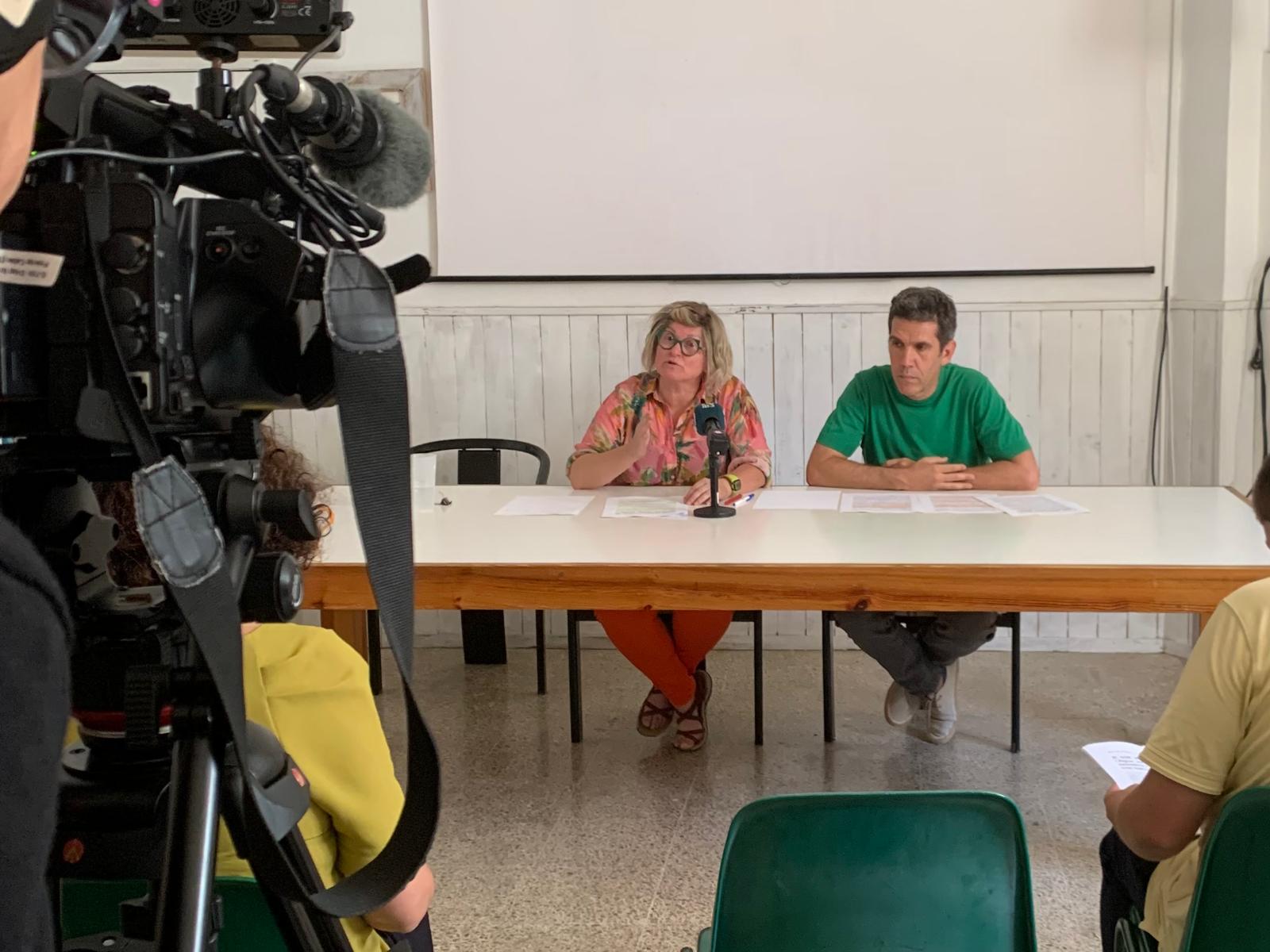
The GOB Mallorca and the Alliance for Water have denounced this Tuesday, June 16, in a press conference that the new 4/2026 of June 11, of urgent measures to accelerate strategic projects, also called the omnibus law, approved by Parliament with the votes of the PP and Vox on May 26, 2026, incorporates an additional provision that allows city councils to approve or develop urban planning without requesting a prior water sufficiency report from the General Directorate of Water Resources of the Government of the Balearic Islands. The measure weakens the main environmental control over urban growth at the worst possible time: when almost six out of ten groundwater bodies in the Balearic Islands are already overexploited, contaminated or salinized.
The entities warn that new changes of use, requalifications, reclassifications or other changes in urban planning previously authorized by the regional hydraulic administration will no longer require their water sufficiency report. Thus, in these cases, the city council will only have to incorporate into the administrative file of the urban planning, a report that accredits the non-existence of new demands for water resources or purification capacity, without any kind of verification and control of compliance with water sufficiency by the General Directorate of Water Resources.
Three successive regulations that trigger urban pressure on the territory and water
The GOB Mallorca and the Alliance for Water highlight that this regulatory change increases the destruction of the territory and the overexploitation of aquifers and is not an isolated event, but the culmination of a sequence of three regulations approved since 2024 in the Balearic Parliament: Law 7/2024 on administrative simplification, Law 4/2025 on urgent actions and now the new omnibus law. All of this allows for more construction on urban and rural land, and at the same time reduces environmental controls on water resources.
The GOB Mallorca recalls that together with social and environmental organizations of the Balearic Islands, they launched an appeal of unconstitutionality last October on Law 7/2024 on administrative simplification. The appeal states that the regulation violates the principle of legal certainty, affects municipal and island autonomy, fails to comply with basic state legislation, reduces the protection of rural land and provides for a covert amnesty, among other things. In addition, the GOB Mallorca filed a complaint with the European Commission for violation of European Law of Law 4/2025 on urgent actions, as well as of the aforementioned Law 7/2024. In this case, the GOB Mallorca warned that the authorization and promotion of large residential developments without sufficient accreditation of water resources violates the European Water Directive 2000/60/EC (DMA), in particular the principle of non-deterioration of art. This constitutes a flagrant breach of the “non-deterioration” principle of the Directive and may lead to a systemic failure to meet European water quality objectives.
A structural water crisis, already visible in municipalities
The GOB and the Alliance for Water warn that urban growth is causing greater pressure on aquifers, causing a generalized situation of overexploitation and contamination of groundwater in the Balearic Islands. Thus, the entities point out that urban and residential uses on rustic land are the largest consumers of water in our islands, far above agricultural and industrial uses. According to data from the current Hydrological Plan of the Balearic Islands, the sum of urban use in the network and dispersed or residential consumption represents more than 70% of all water consumed in the Islands, while agricultural use accounts for 22% and industry, only 3%. The weight of urban and residential consumption is even higher on the smaller islands: 94% in Formentera, 89% in Ibiza, 73% in Menorca and 65% in Mallorca. It is, therefore, urban growth, and not agricultural or industrial activity, which is driving up the demand for water and causing the current overexploitation of aquifers.
In this sense, the entities warn that, according to the initial documents of the fourth hydrological planning cycle (2028-2033) of the Government of the Balearic Islands, 60% of the groundwater bodies of the Balearic Islands are in poor condition due to overexploitation, salinization or nitrate pollution. The high degree of poor condition of groundwater is seen by island: 53% in Mallorca; 66% in Menorca; 81% in Ibiza and 100% in Formentera. In addition, the entities highlight that this overexploitation of aquifers has already translated into real problems. In the summer of 2025, at least seven municipalities in Mallorca applied restrictions on the consumption of drinking water (Sóller, Fornalutx, Montuïri, Algaida, Esporles, Deià and Pollença), with the community's reserves falling to 41%; in the Serra de Tramuntana, Esporles and Puigpunyent had to approve cuts. In Sa Pobla, the aquifer is both overexploited (over 105%) and contaminated by nitrates and chlorides; and in Maó, nearly 7.300 homes received water unfit for human consumption for months due to excess nitrates. Added to all this is the pressure of tourism: a tourist can use up to six times more water than a resident.
But the most worrying thing of all is that while Parliament approves regulations to enable more urban growth, high water losses in the urban supply networks of many municipalities remain. This makes overexploitation stronger because more water must be extracted due to all the water that is lost in the pipes until it reaches our homes. This situation is quite widespread in Mallorca where the poor state of the aquifers and high losses in the networks are repeated (67% in Campos, 54% in Artà or 35% in Sa Pobla). On the islands of Ibiza and Menorca we also find this situation in the municipalities of Sant Josep, Santa Eulària, or Ciutadella. All of this produces a negative vicious circle of continued overexploitation until, in many cases, the aforementioned water cuts and loss of water quality in our taps.
The deficit in purification capacity, a pending issue
Furthermore, the GOB and the Alliance denounce that water sufficiency is not only about drinking water, given that article 43 of the PHIB also requires proving the capacity to purify wastewater before authorizing new growth. In this sense, the entities warn that Palma does not currently have sufficient purification capacity, as do many other municipalities on the islands. The new Palma treatment plant (EDAR Palma II) has been declared of general interest to the State since 1993, but will not be fully operational until, at least, August 2027: more than three decades late. Meanwhile, the current plant cannot treat all the flow it receives nor does it comply with European Directive 91/271/EEC, with untreated discharges into the bay and repeated beach closures.
The problem is not limited to Palma: in Ibiza, the new Sa Coma treatment plant, which purifies the waters of the municipalities of Ibiza, Sant Antoni and Santa Eulària, took fifteen years to build and, in the meantime, poorly purified water was discharged into the marine environment. The Portmany bay also received a "black flag" for poor purification. In Formentera, the expansion of the treatment plant was not tendered until 2025 after ten years of processing; and several coastal areas are in poor condition (the ports of Palma, Alcúdia, Maó and Vila). The entities denounce that allowing new growth without verifying the purification capacity, one of the controls that the exception allows to avoid, aggravates a risk that already affects the quality of coastal waters and public health.
The new regulatory change has a risk of nullity
The GOB and the Alliance also indicate that article 25.4 of the Consolidated Text of the Water Law requires a prior report to be issued on plans that involve new demands. Likewise, article 43 of the PHIB (Royal Decree 49/2023) regulates the sufficiency of resources and purification capacity. Both regulations require, among other requirements, consumption data for the last five years. The exception for development plans, with a limit of eight years, is not provided for in the PHIB and is contradictory to these requirements; and the municipal report that replaces the report is not equivalent to the independent assessment of the hydraulic administration. In fact, the Water Resources Directorate already indicated in its sufficiency report that the General Urban Planning Plan of Palma did not have enough water for the growth planned until 2038: now, the exception would allow reports like that to be avoided when the Palma City Council promotes changes in land use, reclassifications or other urban growth within the General Plan.
They also warn that the doctrine of the Supreme Court is clear: the omission of the report causes the full nullity of the plan, and the TS has annulled more than 90 of them for not justifying the availability of water. Thus, a recent ruling by the Superior Court of Justice of Catalonia has annulled a modification of the General Metropolitan Plan in Gràcia (Barcelona) for not requesting the water report. Plans approved under the new exception are therefore vulnerable to challenge: in the event of conflict, the PHIB —a regulation approved by state Royal Decree— will prevail over the regional regulation.
The organizations request
For all this, the GOB Mallorca and the Alliance for Water demand:
(1) remove or modify the provision exempting from water sufficiency control;
(2) maintain the Water Resources report as a mandatory and binding procedure, with the updated technical content of article 43 of the PHIB;
(3) stop new urban and tourist growth until sufficient water is guaranteed without increasing the overexploitation of aquifers;
(4) that the housing crisis is not used as an alibi to disable environmental controls. Protecting water is not an obstacle to well-being, but the condition to guarantee it: without water there is no housing, no economic activity, no future for the islands.
(5) that the Ministry for the Ecological Transition and the Demographic Challenge (MITERD) exercise its powers in matters of water to challenge the additional provision of the omnibus law before the Constitutional Court, insofar as it violates article 25.4 of the Consolidated Text of the Water Law, Royal Decree 49/2023 approving the Hydrological Plan of the Balearic Islands and the Water Framework Directive 2000/60/EC, and that in parallel it urges the Government of the Balearic Islands to re-establish mandatory control of water sufficiency as an unavoidable requirement of any urban growth.